


UPLIZNA is now approved for anti-AChR and anti-MuSK Ab+ gMG

INDICATIONS
UPLIZNA®(inebilizumab-cdon) is indicated in adult patients for the treatment of: anti-aquaporin-4 (AQP4) antibody positive neuromyelitis optica spectrum disorder (NMOSD); Immunoglobulin G4-related disease (IgG4-RD); anti-...

UPLIZNA gMG header image
Twice-yearly* UPLIZNA helps patients do more of what moves them1
*Following 2 initial doses, 2 weeks apart.
HCP Icon

Get your patients started on UPLIZNA with the Patient Enrollment Form.

Access Form

What is gMG?

gMG is a rare autoimmune disease with unpredictable symptoms that often remain uncontrolled.3 The core manifestation of gMG is fatigable muscle weakness that can worsen over time.4

What is UPLIZNA? 

UPLIZNA is the first and only FDA-approved CD19-targeted therapy for the treatment of anti-AChR and anti-MuSK Ab+ gMG in adult patients.1

What is UPLIZNA? 

UPLIZNA is the first and only FDA-approved CD19-targeted therapy for the treatment of anti-AChR and anti-MuSK Ab+ gMG in adult patients.1

UPLIZNA binds to CD19 on the surface of B cells, including plasmablasts and plasma cells, the upstream producers of anti-AChR and anti-MuSK autoantibodies.1,2

  • Once bound, UPLIZNA enables antibody-dependent cellular cytolysis, leading to the depletion of B cells1 
  • B-cell counts were reduced below the lower limit of normal by Week 4 in >99% of patients in the combined population and remained below the lower limit of normal in ≥96% of patients treated with UPLIZNA in the anti-AChR Ab+ population for 52 weeks, and in >96% of patients treated with UPLIZNA in the anti-MuSK Ab+ population for 26 weeks1,†
    • Pharmacodynamics of UPLIZNA were assessed with a CD20+ B-cell assay as UPLIZNA can interfere with a CD19+ B-cell assay1
  • UPLIZNA reduces autoantibodies that initiate key disease processes (eg, blocking, cross modulation [cross-linking and internalization], complement-mediated damage, and disruption of the AChR clustering process)2,5

The mechanism by which UPLIZNA exerts its therapeutic effect in gMG is unknown1

Overall population includes anti-AChR and anti-MuSK Ab+ patients. A CD20+ B-cell assay was used as UPLIZNA can interfere with the CD19+ B-cell assay.

Clinical Data

UPLIZNA was studied in a randomized double-blind placebo controlled phase 3 study in 238 adult patients with gMG.1

MINT is the largest phase 3 study to include both anti-AChR and anti-MuSK Ab+ gMG patients to date1,6-12

N=238 anti-AChR Ab+ patients: n=190, 52 week RCP anti-MuSK Ab+ patients: n=48, 26 week RCP

Among phase 3 randomized, controlled clinical trials of approved biologic gMG therapies

Efficacy

UPLIZNA delivered deep, durable disease control through 26 weeks as steroids were tapered to ≤5 mg/day2,‡

Primary Endpoint: Change from baseline in MG-ADL score at Week 26 in the combined trial population (anti-AChR and anti-MuSK Ab+)1,2

Efficacy in patients with AChR+ MuSK+ gMG chart Efficacy in patients with AChR+ MuSK+ gMG chart
  • A -2.6 point improvement in MG-ADL was observed with UPLIZNA at Week 4 while a -2.5 point improvement was observed for placebo13
  • 68.7% of patients receiving UPLIZNA had a ≥3-point difference in MG-ADL score (vs 48.2% of patients on placebo).2 A ≥3-point difference in MG-ADL score was an additional secondary endpoint and has not been adjusted for multiple comparisons. No conclusions of statistical or clinical significance can be drawn.2

Results at Week 4 were not a prespecified endpoint and ≥3-point difference in MG-ADL score was an additional secondary endpoint. Neither of these results have been adjusted for multiple comparisons. No conclusions of statistical or clinical significance can be drawn.

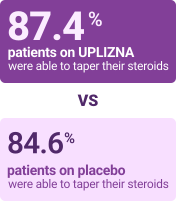
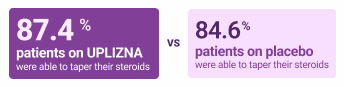
Among patients with baseline steroid use of >5 mg/day, 87.4% of patients in the UPLIZNA group and 84.6% of patients in the placebo group were able to taper their steroids to ≤5 mg/day by Week 26.

Safety Data

UPLIZNA has an established safety profile2

Adverse events with an incidence of at least 5% with UPLIZNA and a greater incidence than placebo2,§

UPLIZNA
N=119
Placebo
N=119
Headache 15% 7%
Infusion-related reaction** 10% 6%
Cough 7% 3%
Nasopharyngitis 7% 3%
Urinary tract infection 7% 3%

§Based on the overall randomized controlled period, comprised of 52 weeks for the anti-AChR antibody positive population and 26 weeks for the anti-MuSK antibody positive population

**Infusion-related reaction was defined as any sign or symptom experienced by patients during the infusion of study drug, or any adverse event occurring within 24 hours of study drug administration for which an alternative explanation was not evident.

Dosing

UPLIZNA is the only approved treatment for adult patients with anti-AChR or anti-MuSK Ab+ gMG delivered twice-yearly,* offering 6 months of infusion-free time between doses.1

Each infusion of UPLIZNA is administered over ~90 minutes1

*Following 2 initial doses, 2 weeks apart.

Infusion icon
Administering UPLIZNA1
  • Prior to initiating UPLIZNA, perform hepatitis B screening, test for quantitative serum immunoglobulins, and evaluate for active tuberculosis and test for latent infection
  • Administer all immunizations according to immunization guidelines at least 4 weeks prior to initiation of UPLIZNA for live or live-attenuated vaccines
  • Prior to every infusion of UPLIZNA, determine whether there is an active infection. In case of active infection, delay infusion of UPLIZNA until the infection resolves
  • A corticosteroid is given 30 minutes prior, and an antihistamine and an antipyretic are given 30 to 60 minutes prior to administration to reduce infusion reactions
  • Monitor the patient closely for infusion reactions during and for at least 1 hour after the completion of the infusion
Patient monitoring icon
Patient monitoring1
Patient monitoring1
  • Advise females of reproductive potential to use effective contraception while receiving UPLIZNA and for at least 6 months after the last dose
  • Monitor the levels of quantitative serum immunoglobulins during treatment with UPLIZNA, especially in patients with opportunistic or recurrent infections, and until B-cell repletion after discontinuation of therapy

Get Patients Started on UPLIZNA—2 Easy Options

Flower icon
Patient Enrollment Form

Download the form, complete it with your patient, including HCP signature, and submit it by fax or email.

Download
OR
Flower icon
DocuSign® Patient Enrollment Form

Access the form and complete it entirely online with HCP e-signature.

Complete Form

AChR, acetylcholine receptor Ab+, antibody positive; HCP, healthcare professional; IgG, immunoglobulin G; MG-ADL, Myasthenia Gravis Activities of Daily Living; MuSK, muscle specific tyrosine kinase; RCP, randomized controlled period.

IMPORTANT SAFETY INFORMATION AND INDICATIONS

CONTRAINDICATIONS

UPLIZNA® (inebilizumab-cdon) is contraindicated in patients with a history of a life-threatening infusion reaction to UPLIZNA, active hepatitis B infection, or active or untreated latent tuberculosis.

WARNINGS AND PRECAUTIONS

  • Infusion Reactions: Infusion reactions, including anaphylaxis, can occur. Symptoms can include headache, nausea, somnolence, dyspnea, fever, myalgia, rash, or palpitations. Infusion reactions were observed in 9.3%, 7.4%, and 10.1% of patients treated with UPLIZNA during the randomized controlled periods (RCPs) of Study 1 in patients with NMOSD, Study 2 in patients with IgG4-RD, and Study 3 in patients with gMG, respectively. Infusion reactions were most common with the first infusion but were also observed during subsequent infusions.

    Administer pre-medication with a corticosteroid, an antihistamine, and an antipyretic. For life-threatening infusion reactions, immediately and permanently stop UPLIZNA and administer appropriate supportive treatment. For less severe infusion reactions, management may involve temporarily stopping the infusion, reducing the infusion rate, and/or administering symptomatic treatment.
  • Infections: Serious, including life-threatening or fatal, bacterial, fungal, and new or reactivated viral infections have been observed during and following completion of treatment with B-cell depleting therapies, including UPLIZNA. The most common infections reported by UPLIZNA-treated patients in the NMOSD randomized and open-label clinical trial periods for NMOSD were urinary tract infection (20%), nasopharyngitis (13%), upper respiratory tract infection (8%), and influenza (7%). In the IgG4-RD RCP, the most common infections reported by UPLIZNA-treated patients were urinary tract infection, influenza, and pneumonia. In the gMG RCP, the most common infections reported by UPLIZNA-treated patients were urinary tract infection and nasopharyngitis. Delay UPLIZNA administration in patients with an active infection until the infection is resolved.

    Possible Increased Risk of Immunosuppressant Effects with Other Immunosuppressants: If combining UPLIZNA with another immunosuppressive therapy, consider the potential for increased immunosuppressive effects.

    Hepatitis B Virus (HBV) Reactivation: HBV reactivation has been observed with B-cell-depleting therapies, including UPLIZNA. Fulminant hepatitis, hepatic failure, and death caused by HBV reactivation have occurred in patients treated with B-cell depleting therapies. HBV reactivation was observed in a patient treated with UPLIZNA during the gMG clinical trial and in the postmarketing setting. Patients with active or chronic HBV infection were excluded from clinical trials. Perform HBV screening in all patients before initiation of treatment. Do not administer to patients with active HBV confirmed by positive results for HBsAg and anti-HB tests. For patients who are negative for HBsAg and positive for HBcAb, or who are carriers of HBV (i.e., HBsAg+), consult liver disease experts before starting and during treatment.

    Progressive Multifocal Leukoencephalopathy (PML): Although no confirmed cases of PML were identified in UPLIZNA clinical trials, JC virus infection resulting in PML has been observed in patients treated with other B-cell-depleting antibodies and other therapies that affect immune competence. In UPLIZNA clinical trials one subject died following the development of new brain lesions for which a definitive diagnosis could not be established, though the differential diagnosis included an atypical NMOSD relapse, PML, or acute disseminated encephalomyelitis. At the first sign or symptom suggestive of PML, withhold UPLIZNA and perform an appropriate diagnostic evaluation. MRI findings may be apparent before clinical signs or symptoms. Typical symptoms associated with PML are diverse, progress over days to weeks, and include progressive weakness on one side of the body or clumsiness of limbs, disturbance of vision, and changes in thinking, memory, and orientation leading to confusion and personality changes.

    Tuberculosis
    Patients should be evaluated for tuberculosis risk factors and tested for latent infection prior to initiating UPLIZNA. Consider anti-tuberculosis therapy prior to initiation of UPLIZNA in patients with a history of latent active tuberculosis in whom an adequate course of treatment cannot be confirmed, and for patients with a negative test for latent tuberculosis but having risk factors for tuberculosis infection. Consult infectious disease experts regarding whether initiating anti-tuberculosis therapy is appropriate before starting treatment.

    Vaccinations
    Administer all immunizations according to immunization guidelines at least 4 weeks prior to initiation of UPLIZNA. The safety of immunization with live or live-attenuated vaccines following UPLIZNA therapy has not been studied, and vaccination with live-attenuated or live vaccines is not recommended during treatment and until B-cell repletion.
    Vaccination of Infants Born to Mothers Treated with UPLIZNA During Pregnancy
    In infants of mothers exposed to UPLIZNA during pregnancy, do not administer live or live-attenuated vaccines before confirming recovery of B-cell counts in the infant. Depletion of B cells in these exposed infants may increase the risks from live or live-attenuated vaccines. Non-live vaccines, as indicated, may be administered prior to recovery from B-cell and immunoglobulin level depletion, but consultation with a qualified specialist should be considered to assess whether a protective immune response was mounted.
  • Reductions in Immunoglobulins: There may be a progressive and prolonged hypogammaglobulinemia or decline in the levels of total and individual immunoglobulins such as immunoglobulins G and M (IgG and IgM) with continued UPLIZNA treatment. Monitor the levels of quantitative serum immunoglobulins during treatment with UPLIZNA, especially in patients with opportunistic or recurrent infections, and until B-cell repletion after discontinuation of therapy. Consider discontinuing UPLIZNA therapy if a patient with low immunoglobulin G or M develops a serious opportunistic infection or recurrent infections, or if prolonged hypogammaglobulinemia requires treatment with intravenous immunoglobulins.
  • Fetal Risk: Based on animal data, UPLIZNA can cause fetal harm due to B-cell lymphopenia and reduce antibody response in offspring exposed to UPLIZNA even after B-cell repletion. Transient peripheral B-cell depletion and lymphocytopenia have been reported in infants born to mothers exposed to other B-cell-depleting antibodies during pregnancy. Advise females of reproductive potential to use effective contraception while receiving UPLIZNA and for at least 6 months after the last dose.

ADVERSE REACTIONS

  • The most common adverse reactions (at least 10% of patients treated with UPLIZNA and greater than placebo): urinary tract infection and arthralgia in NMOSD; urinary tract infection and lymphopenia in IgG4-RD; headache and infusion-related reactions in gMG.

INDICATIONS

UPLIZNA® (inebilizumab-cdon) is indicated in adult patients for the treatment of: anti-aquaporin-4 (AQP4) antibody positive neuromyelitis optica spectrum disorder (NMOSD); Immunoglobulin G4-related disease (IgG4-RD); anti-acetylcholine receptor (AChR) or anti-muscle specific tyrosine kinase (MuSK) antibody positive (Ab+) generalized myasthenia gravis (gMG).

Please see UPLIZNA® full Prescribing Information.

IMPORTANT SAFETY INFORMATION AND INDICATIONS

CONTRAINDICATIONS

UPLIZNA® (inebilizumab-cdon) is contraindicated in patients with a history of a life-threatening infusion reaction to UPLIZNA, active hepatitis B infection, or active or untreated latent tuberculosis.

WARNINGS AND PRECAUTIONS

  • Infusion Reactions: Infusion reactions, including anaphylaxis, can occur. Symptoms can include headache, nausea, somnolence, dyspnea, fever, myalgia, rash, or palpitations. Infusion reactions were observed in 9.3%, 7.4%, and 10.1% of patients treated with UPLIZNA during the randomized controlled periods (RCPs) of Study 1 in patients with NMOSD, Study 2 in patients with IgG4-RD, and Study 3 in patients with gMG, respectively. Infusion reactions were most common with the first infusion but were also observed during subsequent infusions.
    Administer pre-medication with a corticosteroid, an antihistamine, and an antipyretic. For life-threatening infusion reactions, immediately and permanently stop UPLIZNA and administer appropriate supportive treatment. For less severe infusion reactions, management may involve temporarily stopping the infusion, reducing the infusion rate, and/or administering symptomatic treatment.

  • Infections: Serious, including life-threatening or fatal, bacterial, fungal, and new or reactivated viral infections have been observed during and following completion of treatment with B-cell depleting therapies, including UPLIZNA. The most common infections reported by UPLIZNA-treated patients in the NMOSD randomized and open-label clinical trial periods for NMOSD were urinary tract infection (20%), nasopharyngitis (13%), upper respiratory tract infection (8%), and influenza (7%). In the IgG4-RD RCP, the most common infections reported by UPLIZNA-treated patients were urinary tract infection, influenza, and pneumonia. In the gMG RCP, the most common infections reported by UPLIZNA-treated patients were urinary tract infection and nasopharyngitis. Delay UPLIZNA administration in patients with an active infection until the infection is resolved.

    Possible Increased Risk of Immunosuppressant Effects with Other Immunosuppressants: If combining UPLIZNA with another immunosuppressive therapy, consider the potential for increased immunosuppressive effects.

    Hepatitis B Virus (HBV) Reactivation: HBV reactivation has been observed with B-cell-depleting therapies, including UPLIZNA. Fulminant hepatitis, hepatic failure, and death caused by HBV reactivation have occurred in patients treated with B-cell depleting therapies. HBV reactivation was observed in a patient treated with UPLIZNA during the gMG clinical trial and in the postmarketing setting. Patients with active or chronic HBV infection were excluded from clinical trials. Perform HBV screening in all patients before initiation of treatment. Do not administer to patients with active HBV confirmed by positive results for HBsAg and anti-HB tests. For patients who are negative for HBsAg and positive for HBcAb, or who are carriers of HBV (i.e., HBsAg+), consult liver disease experts before starting and during treatment

    Progressive Multifocal Leukoencephalopathy (PML): Although no confirmed cases of PML were identified in UPLIZNA clinical trials, JC virus infection resulting in PML has been observed in patients treated with other B-cell-depleting antibodies and other therapies that affect immune competence. In UPLIZNA clinical trials one subject died following the development of new brain lesions for which a definitive diagnosis could not be established, though the differential diagnosis included an atypical NMOSD relapse, PML, or acute disseminated encephalomyelitis. At the first sign or symptom suggestive of PML, withhold UPLIZNA and perform an appropriate diagnostic evaluation. MRI findings may be apparent before clinical signs or symptoms. Typical symptoms associated with PML are diverse, progress over days to weeks, and include progressive weakness on one side of the body or clumsiness of limbs, disturbance of vision, and changes in thinking, memory, and orientation leading to confusion and personality changes.

    Tuberculosis
    Patients should be evaluated for tuberculosis risk factors and tested for latent infection prior to initiating UPLIZNA. Consider anti-tuberculosis therapy prior to initiation of UPLIZNA in patients with a history of latent active tuberculosis in whom an adequate course of treatment cannot be confirmed, and for patients with a negative test for latent tuberculosis but having risk factors for tuberculosis infection. Consult infectious disease experts regarding whether initiating anti-tuberculosis therapy is appropriate before starting treatment.

    Vaccinations
    Administer all immunizations according to immunization guidelines at least 4 weeks prior to initiation of UPLIZNA. The safety of immunization with live or live-attenuated vaccines following UPLIZNA therapy has not been studied, and vaccination with live-attenuated or live vaccines is not recommended during treatment and until B-cell repletion.
    Vaccination of Infants Born to Mothers Treated with UPLIZNA During Pregnancy
    In infants of mothers exposed to UPLIZNA during pregnancy, do not administer live or live-attenuated vaccines before confirming recovery of B-cell counts in the infant. Depletion of B cells in these exposed infants may increase the risks from live or live-attenuated vaccines. Non-live vaccines, as indicated, may be administered prior to recovery from B-cell and immunoglobulin level depletion, but consultation with a qualified specialist should be considered to assess whether a protective immune response was mounted.
  • Reductions in Immunoglobulins: There may be a progressive and prolonged hypogammaglobulinemia or decline in the levels of total and individual immunoglobulins such as immunoglobulins G and M (IgG and IgM) with continued UPLIZNA treatment. Monitor the levels of quantitative serum immunoglobulins during treatment with UPLIZNA, especially in patients with opportunistic or recurrent infections, and until B-cell repletion after discontinuation of therapy. Consider discontinuing UPLIZNA therapy if a patient with low immunoglobulin G or M develops a serious opportunistic infection or recurrent infections, or if prolonged hypogammaglobulinemia requires treatment with intravenous immunoglobulins.
  • Fetal Risk: Based on animal data, UPLIZNA can cause fetal harm due to B-cell lymphopenia and reduce antibody response in offspring exposed to UPLIZNA even after B-cell repletion. Transient peripheral B-cell depletion and lymphocytopenia have been reported in infants born to mothers exposed to other B-cell-depleting antibodies during pregnancy. Advise females of reproductive potential to use effective contraception while receiving UPLIZNA and for at least 6 months after the last dose.

ADVERSE REACTIONS

  • The most common adverse reactions (at least 10% of patients treated with UPLIZNA and greater than placebo): urinary tract infection and arthralgia in NMOSD; urinary tract infection and lymphopenia in IgG4-RD; headache and infusion-related reactions in gMG.

INDICATIONS

UPLIZNA® (inebilizumab-cdon) is indicated in adult patients for the treatment of: anti-aquaporin-4 (AQP4) antibody positive neuromyelitis optica spectrum disorder (NMOSD); Immunoglobulin G4-related disease (IgG4-RD); anti-acetylcholine receptor (AChR) or anti-muscle specific tyrosine kinase (MuSK) antibody positive (Ab+) generalized myasthenia gravis (gMG).

Please see UPLIZNA® full Prescribing Information.